How Sweet It Is to Be Loved by You Wall Art
O n the morning of the day of the Euro 2020 final, Westminster Bridge is already bustling with football game fans and England flags, simply down by the riverside hush prevails. On the Albert Embankment, in that location is a wall, about a 3rd of a mile long and shaded by plane trees, which runs aslope St Thomas' hospital and looks out over the Thames at the palace of Westminster. Before 29 March this year, it was just a wall; now it is decorated with more than 150,000 cerise hearts, each one representing a life lost to Covid-xix. Even the Sunday runners look a piddling sheepish about jogging by a memorial to the UK's largest peacetime mass trauma outcome in more a century.
As I walk forth what is in effect the national Covid memorial, past occasional photographs, wilting bouquets and painted stones, I read shattering stories told in just a few words. There's one dedication to a hubby and wife who died 9 hours apart and some other that must have been written past a NHS worker: "TO ALL THOSE I COULD Non SIT WITH… I'G Pitiful." Sometimes, hearts are tied together by pen similar a bunch of balloons, to encompass messages from entire families. Certain phrases recur, like mantras of remembrance. In loving memory. We will always remember you. Gone but not forgotten.
A national memorial to the victims of a catastrophe is ordinarily a delicate and circuitous negotiation between the government and the families of the dead. The process is long and never without controversy. The residents of Hiroshima argued for years about whether to preserve the ruins of the metropolis'due south industrial promotion hall as a peace memorial. Maya Lin's celebrated Vietnam veterans memorial in Washington DC was initially derided past opponents as an "open up urinal" and "Orwellian glop". It took a decade to select and construct Reflecting Absence, the 9/11 memorial in Manhattan. Boris Johnson has promised a commission on Covid commemoration but what form, and how long it volition have, is anyone's guess.
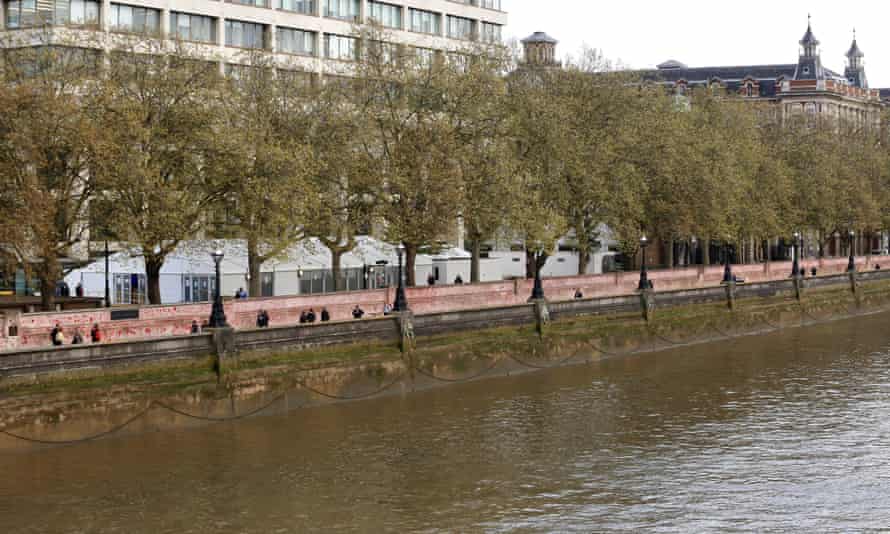
The Covid memorial wall is peradventure unique. Established past the bereaved themselves, without official permission, it has attracted nothing only praise. People outside London tin request a dedication just many want to make the journey themselves. On Sunday morning time, I talk to two such families. "It's the offset fourth dimension we've felt comfortable coming down hither," says Anna from East Sussex, as she writes a dedication to her father, Jan Szymanski. Stacey and Karen from Essex have come to memorialise their mother, Junie Sheridan, on the half dozen-month anniversary of her decease.
In a New Yorker contour of Lin, Louis Menand wrote: "Now we expect a memorial will be interactive and that information technology volition visibly motility the viewer. If it doesn't make you cry, so it isn't working." The Covid memorial wall is working.
So far, information technology has been solely attributed to Covid-19 Bereaved Families for Justice Britain, only the guerrilla activist group Led Past Donkeys – Ben Stewart, Oliver Knowles, James Sadri and Will Rose – accept chosen the eve of so-called "freedom 24-hour interval" to reveal their crucial role in the project because they will be launching a digital wall online, featuring sound testimony from the bereaved. Best known for their anti-Brexit campaigning, the iv men kept their interest secret even from the volunteers so every bit to avoid any impression that the project was politically partisan. But all memorials are political on some level considering people died who need not take died and someone was responsible. You cannot think who without raising the questions of how and why. Indeed, the wall would not exist if non for a sense that the government couldn't be trusted with the task of memorialisation.
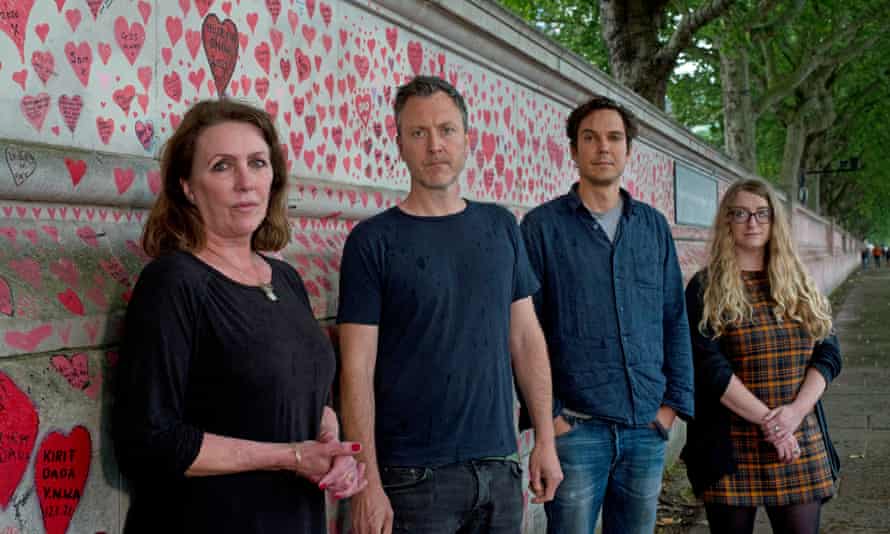
"We wanted to talk virtually who owns memory and who gets to tell this story," says Stewart. "At that place's that Orwell quote - 'Who controls the past controls the future; who controls the nowadays controls the past.' Are the government going to endeavor to control the retentivity of this and are they perhaps a singularly inappropriate institution to do that, given the very serious questions almost how they've conducted it? Nosotros need to recollect the scale of the loss here. If someone had said 150,000 in December 2019 you would have thought, how could United kingdom of great britain and northern ireland sustain that level of loss? And all the same nosotros did."
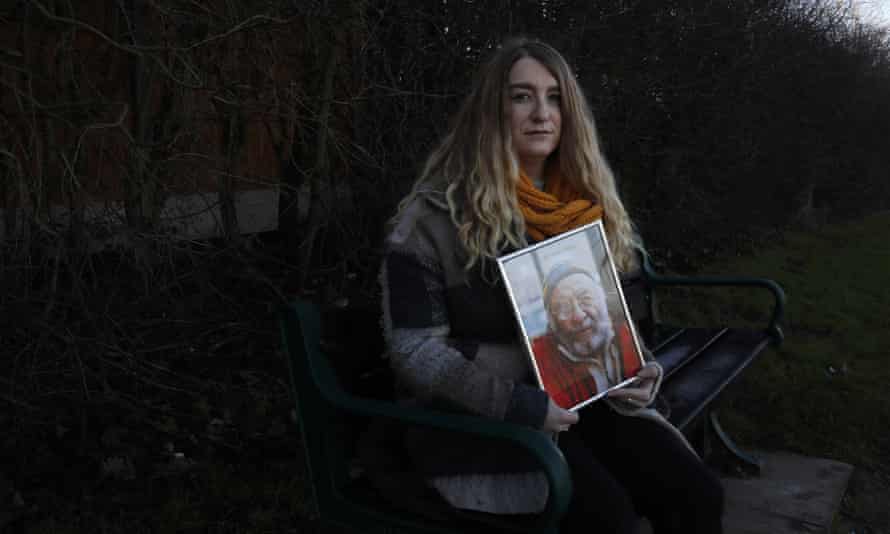
50 ast March, Jo Goodman moved from London to her family domicile in Norwich to stay with her 72-year-old begetter, Stuart, a retired press photographer who was most to begin cancer treatment. A calendar week earlier the first lockdown, Jo begged him to miss his latest hospital engagement, only he assured her that he wouldn't be invited if it wasn't safe. "He trusted the NHS, but I think actually who he was trusting was the authorities," Jo says. A week later, he began experiencing symptoms of Covid-19. By 2 April he was dead. The funeral omnipresence was limited to 10 people.
Afterwards, Goodman couldn't get past her acrimony at those who had failed to protect people such every bit Stuart. "I felt it was wrong – almost more strongly than I felt the grief. I was really struggling." Through a friend, she spoke to a journalist. When the article was posted on Facebook, ane reader commented that he, also, had lost a begetter and he, as well, blamed the regime.
Before he got Covid, Matt Fowler's father, Ian, a former engineer for Jaguar Land Rover in Nuneaton, was enjoying early on retirement. He was admitted to hospital on the first twenty-four hours of the lockdown and died on 13 April at the age of 56. "Equally far as I was concerned, Dad'southward death was preventable," says Fowler. "If we'd been ameliorate prepared for Covid hitting the Great britain'due south shores, a lot of people could have been protected. I felt powerless. I was just one guy on his own. Then I came across the article nearly Jo's dad and told her I understood exactly where she was coming from."
Goodman and Fowler immediately set upwardly a Facebook group. Covid-nineteen Bereaved Families for Justice UK began as a bereavement support group, but shortly evolved into a entrada for an immediate public enquiry into the government's management of the pandemic, with a rapid review phase to avert similar mistakes during the inevitable 2d moving ridge. They repeatedly sought a meeting with the prime minister. Cipher happened. "We realised that we were a bit out of our depth," says Goodman. "Nosotros needed to exercise something to be heard." Last September, they put out a call for experienced campaigners and Led By Donkeys responded.
Stewart, Knowles, Sadri and Rose are four friends and seasoned Greenpeace campaigners in their 40s who met in a pub in Stoke Newington, north London one nighttime in December 2018 and conceived a program to remind the public of sometime tweets that the architects of Brexit would rather forget. They started by plastering a poster of an infamous David Cameron tweet on to a billboard near the pub. The image went viral on Twitter so they kept going, eventually relinquishing their anonymity in an interview with the Observer in May 2019. Funded entirely past public donations, they expanded their anti-Brexit campaign to include videos, projections and interactive art installations, but that mission ended with the Conservatives' general election victory. On 31 Jan 2020, the mean solar day the UK left the Eu, Led Past Donkeys projected a video on to the white cliffs of Dover of state of war veterans talking about the EU as a peace projection and hoping that the Great britain would one day rejoin it. The group became known for exposing the hypocrisy of those in power, but that motion picture found an elegiac new emotional annals that prioritised the voices of ordinary people over the mendacity of politicians.
By adventure, that was also the solar day that the country'due south first 2 cases of Covid-xix were confirmed in York. Led By Donkeys presently put their mail service-Brexit plans on ice. "We didn't immediately jump at it because we didn't want to snipe for the sake of sniping," says Stewart. "I wanted Boris Johnson to succeed. Only what emerged very quickly was that he was approaching the pandemic with his usual boosterism and thermonuclear incompetence. We only do something if we've got something to say, which is that the government is fucking this up."
Last November, Led By Donkeys worked with Goodman and Fowler on a curt film of relatives telling personal stories of grief and made it hard to ignore by projecting information technology on to the palace of Westminster. The 2 groups then began talking about creating some kind of memorial that would convey both the scale of the expiry price and the individuality of the victims. "It felt like people were sick of hearing most the pandemic and wanted to move on," says Goodman. "There was a sense that our loved ones were becoming a statistic. How do yous prove that they're people?"
When the expiry price striking 100,000 on 26 Jan, and Johnson pledged to establish a memorial merely "when we have come through this crisis", the need became more urgent. At that place were various suggestions – handprints, candles, ranks of shoes – only the concept of a wall of hearts was at one time elegantly simple, emotionally immediate and logistically feasible. "Each of those mitt-painted hearts being unique and individual represents a unique and individual person who died," says Fowler. "That is a much more than plumbing equipment memorial than a plaque or a statue." Goodman realised that people would want to write inside the hearts. "I'd want to know which eye represented my dad," she says. "We knew what people would demand from it." The start engagement was fix for Mon 29 March, when groups of six would once again be immune to meet outdoors.
While Goodman and Fowler consulted other bereavement groups, Knowles cycled around to spotter potential locations. Every bit well every bit having political value, the St Thomas' wall was large enough and, for central London, relatively serene. The next challenge was finding 10,000 Posca pens, a brand favoured past street artists because of its resilience. With help from the Bristol street fine art gallery Upfest, the group bought every broad-nibbed cherry Posca pen in the country. Some other task was making sure they painted enough 8cm by 8cm hearts to reflect the latest ONS expiry toll, which was a little over 150,000. They calculated that it would take two-and-a-half days for someone to count them all manually, so Rose found a scientist in the US who provided some image recognition software that would tally the hearts every bit they were painted and enable them to hit their target.
50 ed Past Donkeys subscribe to the proverb that it is easier to inquire forgiveness than it is to get permission. When they started plastering billboards 2 years ago, they looked professional past wearing hi-vis jackets and keeping their cool when police force cars went past. "Own the infinite" was Knowles's motto. "We learned that at Greenpeace when you do directly actions," says Stewart. "If you wait like yous're meant to be there, so information technology takes a very brave official to tell yous y'all're non. We idea, what would it expect like if it was all officially signed off?"
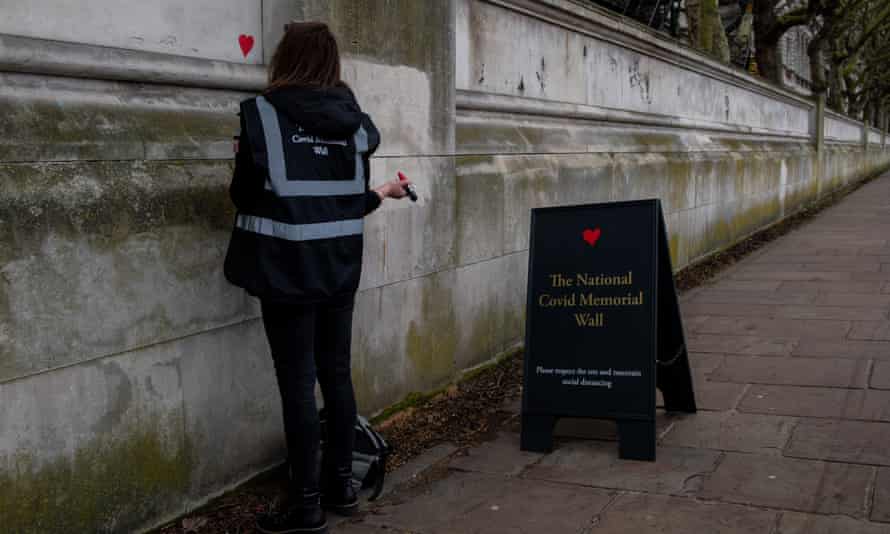
Led By Donkeys staged a full-calibration theatre of legitimacy, dressing the prepare with official-looking national Covid memorial wall plaques, sandwich boards and bouquets of flowers. The group set upwardly a table to cursory volunteers on social distancing and hand out branded tabards and masks. Fowler painted the get-go middle and defended it to his male parent. "The important thing was to become through the showtime 60 minutes," says Stewart. "We felt that the thought was so powerful that as soon as it had manifested 200 hearts, it would be unstoppable." They warned volunteers that they would be technically liable to abort and prosecution for criminal impairment but in the issue their only contact with the police force was an officer who was getting vaccinated in the grounds of the hospital and leaned over the wall to ask Sadri to add his neighbor'southward name to the memorial.
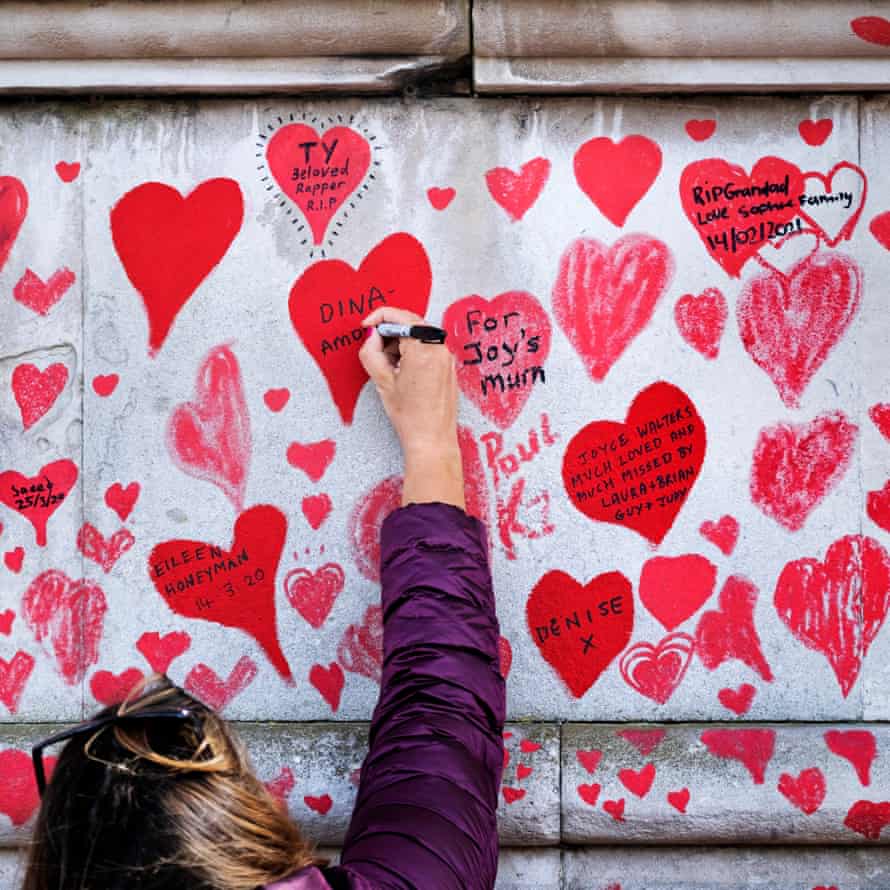
The next obstacle was manpower. They soon realised that with the initial xxx volunteers the painting would take weeks, and then they used media appearances by the bereaved to drive registrations on an events website. They ended up with approximately 1,500 volunteers over 10 days, working in Covid-safe groups of 6 in bizarrely variable weather. "Some days we were dressed like we were in the Arctic and other days nosotros were handing out suncream," says Knowles. "Y'all could hear people up and down the wall saying, 'I've been at home crying every solar day just to come hither and make this public statement with other bereaved families is a real catharsis.' It's a memorial built past the bereaved for the bereaved."
While the Westminster location is an implicit rebuke to politicians, the memorial itself was designed to be universal. "This is primarily a site of mourning," says Sadri. "We shared and then many intimate emotional moments with so many people. Politics felt and then afar." While the security guards who protected the wall during the installation are long gone, people seem to instinctively understand what is appropriate. There is some damning graffiti on an adjacent wall ("THE GOVT HAS FAILED", "Sunak=Fascist") but I spotted only ane such message on the memorial itself.
On twenty-four hours one, Covid-19 Bereaved Families for Justice Great britain emailed every MP with an invitation to come and witness the installation and talk to volunteers. Local MP Florence Eshalomi came that morn, as did the head of Lambeth council. Keir Starmer showed up in the afternoon. Co-ordinate to the families, no Bourgeois MPs materialised during the 10 days, although several did then after, especially after the archbishop of Canterbury walked the wall with a rabbi and an imam on xx April and spoke of "a tidal wave of grief that has not been released".
Johnson finally appeared on 27 April, merely he came after dark and without speaking to the families. It was the solar day afterward it was declared that he had said that he would rather let "bodies pile loftier in their thousands" than impose a tertiary national lockdown, which raised suspicions of an endeavor at reputational rehab.
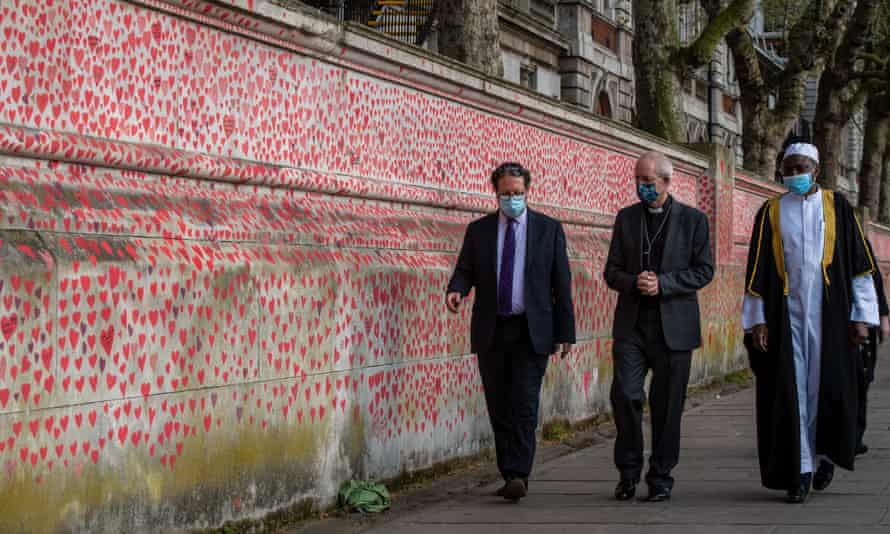
"I am cautiously happy that he visited the wall and took information technology in," says Fowler, who finally has a meeting scheduled with Johnson in September. "But the manner he went about it was very cynical and underhand. It felt insincere, similar he'd done information technology just to say that he'd been. The reason we had invited him to come down when we were there and mind to our stories and concerns is because that's what it's all about: the people."
When I revisit the wall on a glum, rainy Monday evening to run into Fran Hall, she is already at that place with her pens, touching up hearts and messages that take been faded by the elements.
Hall recently set up Friends of the Covid Memorial Wall to remove graffiti, fix weather harm and maintain the visual integrity of the project as all-time she can. Ideally, everybody would write just inside the hearts, she says, "but you can't control it and that's function of the dazzler of it. We're a messy species, aren't we? We don't simply do what we're told."
Hall is a funeral director from Buckinghamshire. Last September, she got married to Steve, her partner of 11 years. A couple of days before the wedding, Steve had a hospital appointment regarding his prostate cancer. Hall only after realised that that was when he virtually likely to have contracted Covid-19 and that he had been asymptomatic when they tied the knot. He was admitted to hospital, simply Hall wasn't allowed to visit him because he was immunocompromised and she had at present tested positive. Three weeks later on their wedding day, and one day earlier his 66th altogether, Steve died.
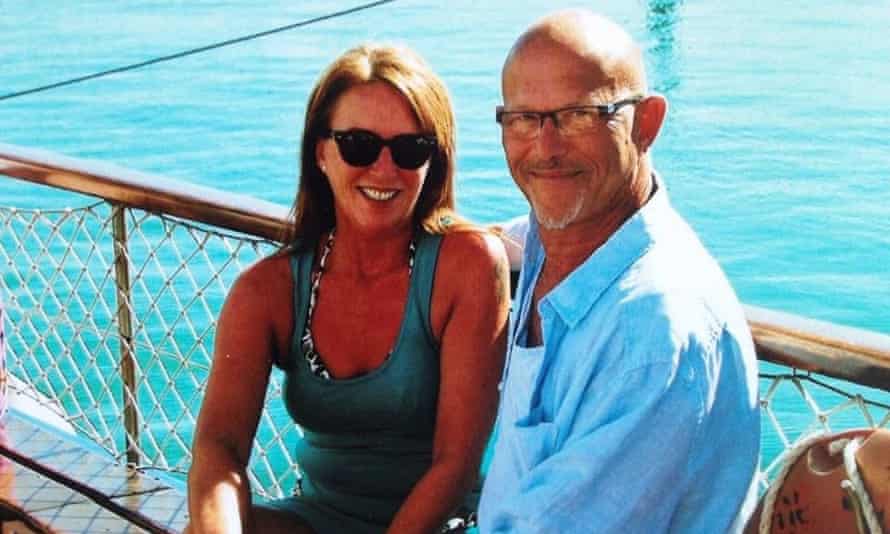
Her grief was a kind of madness, she says, until she came across the bereavement grouping. "I constitute my tribe. I know nigh grief and this is like nothing I've e'er experienced. It's the isolation – not existence able to spend fourth dimension with people – and it's the horrendous way that people dice. This group represented how I felt."
As soon every bit she heard near the wall, she signed upwards for three hours on the Monday but concluded up staying the whole 24-hour interval then coming back every 24-hour interval until it was finished. "I didn't know that I needed information technology as much as I did. I couldn't non come up back. I'd found a community and a purpose. It's helped to aqueduct my grief."
When Goodman arrives, Hall is delighted. They take seen each other on Television set just oasis't really met before. As we walk down the South Bank to become a cup of tea, Goodman talks about the importance of Hall'southward preservation piece of work. "I remember because people experience our loved ones were neglected; when there's a center there that represents them, you desire to have skillful care of it." Goodman has seen pilgrimages made, memorial services held and friendships forged hither. It has already inspired like walls in Texas and Georgia. "It has taken on a life of its own. Now information technology would be very difficult to see it go."
O n 12 June, Labour MP Dawn Butler raised the future of the wall in the Eatables. Butler, who had dedicated a heart to her uncle, called it "an iconic, organic piece of work of art created past bereaved families, and it should not exist removed or painted over". Her Labour colleague Afzal Khan wrote a letter, signed by a cross-party brotherhood including Sadiq Khan, Ed Davey and Peter Bottomley, which called on the government to "make this wall of hearts a, if non the, permanent memorial to the victims of the pandemic". Stewart finds information technology hard to imagine that it will non remain. "It seems inconceivable to me that someone will come up along one day with a sandblaster or some white paint. For some people, that heart on the wall is every bit important as a gravestone."
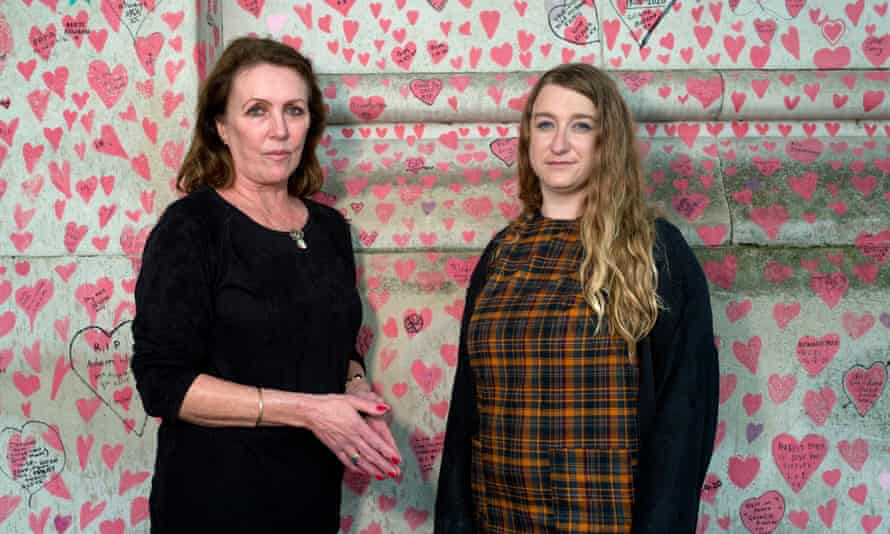
Legally, the fate of the wall rests in the easily of St Thomas' hospital and Lambeth council. There is talk of protecting information technology with plexiglass or lacquer but that would forestall new inscriptions and mean that it ceased to be a living memorial. For now, Hall is happy to keep information technology live and growing. "At what point does something go an official memorial?" asks Sadri. "Who gets to decide that? The source of legitimacy is the families."
The pandemic is something that many of us would like to forget, not least the government. The obsession with "freedom mean solar day" reveals a somewhat manic desire to rush to the end of this dreadful episode in our history and move on. For the bereaved, however, any return to normality volition be incomplete and any talk of forgetting might experience like a betrayal. To call up who died, and why they died, is both emotionally and politically essential.
Everyone who painted the memorial wall, or has inscribed a name on it, belongs to a community united by a decision to remember. To walk along information technology is to be reminded not merely of the devastation of loss but too of the extraordinary magnitude of love. "They say grief is love with nowhere to go," says Goodman. "The wall is where information technology goes."
-
Visit the digital national Covid memorial wall.
wilsondientooltaid.blogspot.com
Source: https://www.theguardian.com/world/2021/jul/18/wall-of-love-the-incredible-story-behind-the-national-covid-memorial-led-by-donkeys
0 Response to "How Sweet It Is to Be Loved by You Wall Art"
Post a Comment